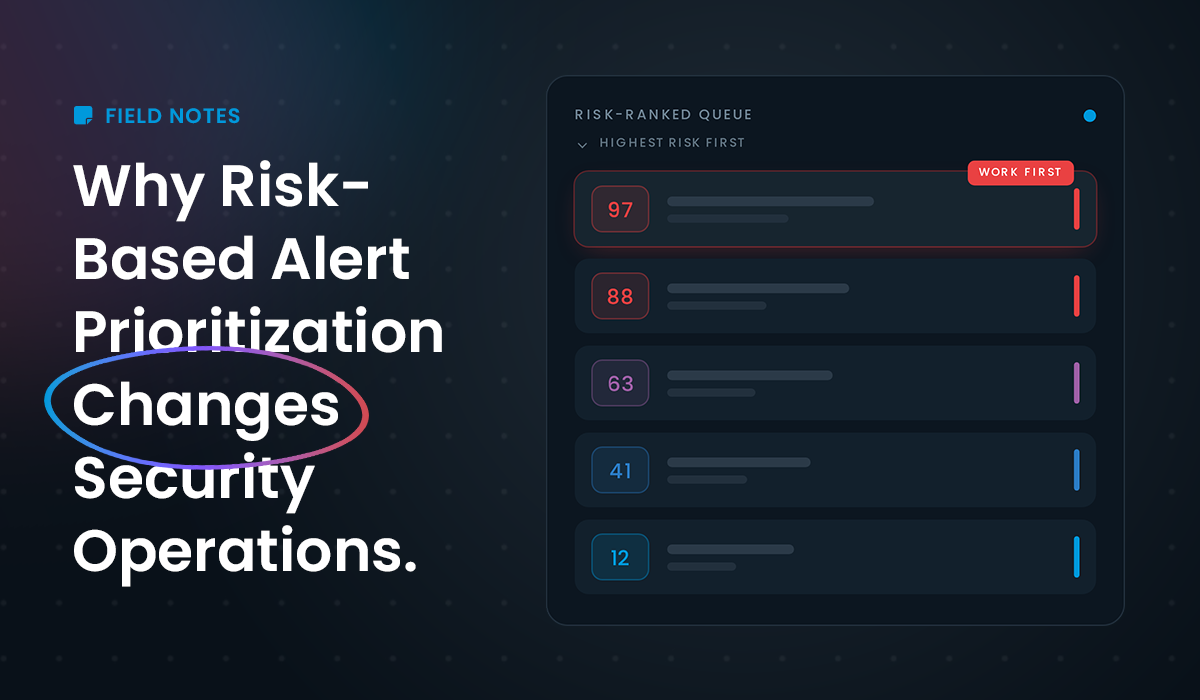
Why Risk, Not Time, Should Drive Your SOC Queue
For years, security operations centers have organized work the same way many IT help desks do: the oldest alert sits at the top of the queue, and analysts work their way down. It's an approach that feels logical. It feels fair. Most importantly, it feels familiar.
The problem is that cybersecurity doesn't operate on fairness; it operates on risk.
An attacker doesn't care how long an alert has been waiting. A ransomware campaign doesn't pause because analysts are still working through lower-priority investigations from earlier in the morning. The threat most likely to disrupt your business isn't necessarily the one that's been sitting in the queue the longest. It's the one that presents the greatest risk right now.
As security operations have matured, many organizations have invested heavily in collecting more telemetry. Endpoints, cloud workloads, identity providers, firewalls, SaaS applications, and networks all generate valuable security data. Yet despite this explosion of visibility, one operational question still determines how efficiently a security team responds:
Which alert deserves attention first? That's where the traditional queue begins to show its age.
Security Inherited a Workflow That Was Never Designed for Security
Chronological queues weren't invented for cybersecurity. They were borrowed from ticketing systems, where first-in, first-out is a perfectly reasonable way to manage work. If someone reports a printer issue before someone else requests a password reset, there's little downside to addressing the oldest request first.
Security incidents don't behave that way.
Imagine two alerts arriving in your SOC:
- An unusual but ultimately low-risk login anomaly that appeared three hours ago
- A high-confidence indicator of ransomware activity that appeared two minutes ago
An age-based queue tells the analyst to investigate the login anomaly first simply because it arrived earlier. A risk-based queue recognizes that the ransomware indicator deserves immediate attention. The distinction sounds subtle, but it fundamentally changes how analysts spend their time. Every queue represents a philosophy about how work should be prioritized. Chronological queues prioritize fairness. Security operations should prioritize risk.
"The most dangerous alert is rarely the oldest one. It's the one carrying the greatest risk right now."
This isn't a criticism of the security teams still working chronological queues today. For years, that approach was a practical default, and many highly capable SOCs continue to operate successfully with it. But defaults are worth revisiting as technology evolves, especially when they originated in a discipline with very different objectives.
The Real Constraint Inside the SOC Isn't Data
Cybersecurity has never suffered from a shortage of alerts. If anything, organizations have become exceptionally good at generating them. Modern security platforms continuously monitor endpoints, identities, cloud environments, email systems, applications, and networks. The result is a constant stream of events competing for analyst attention. Collecting more data is no longer the challenge.
Deciding what deserves attention is. This is why alert fatigue remains one of the defining operational challenges inside today's SOC. Analysts don't simply investigate alerts—they continuously make prioritization decisions. Every investigation represents a tradeoff because every minute spent reviewing one alert is a minute not spent reviewing another.
That makes attention one of the most valuable—and limited—resources in security operations.
When high-risk activity becomes buried beneath dozens of lower-priority events, organizations experience consequences that extend well beyond slower response times.
Common symptoms include:
- Analysts spending valuable time investigating low-risk activity before reaching meaningful threats.
- High-priority incidents remaining buried inside growing queues.
- Increased alert fatigue and analyst burnout.
- Difficulty explaining why certain alerts were investigated before others.
- Reduced confidence that the most important threats are receiving immediate attention.
These aren't failures of people.
They're often the result of workflows that ask talented analysts to work in an order that no longer reflects today's threat landscape.
What Happens When the Queue Starts Thinking About Risk Instead of Time?
One of the questions we asked while building the new ArmorPoint platform was surprisingly simple: What if the queue sorted by risk instead of by age? That idea became one of the foundational principles behind our approach to AI-assisted triage.
Rather than organizing work chronologically, the platform classifies alerts according to risk so analysts can begin with the activity most likely to require immediate attention. It's an important distinction because the goal isn't to eliminate human judgment. It's to make better use of it.
Artificial intelligence has become one of the cybersecurity industry's favorite talking points, but it's also one of its least precise. Too often, AI is presented as though it independently detects, investigates, and resolves incidents without human involvement. That's not only unrealistic—it risks undermining confidence when reality proves more nuanced.
Our philosophy is different. AI helps organize the work. Analysts still perform the investigation. Analysts still determine whether activity is malicious. Analysts still decide how an incident should be handled. Technology improves the order in which work appears. People remain responsible for the decisions that follow. That's a distinction we think matters.
Security operations don't become more effective by removing analysts from the process. They become more effective by helping analysts spend their expertise where it creates the greatest value.
Better Prioritization Creates Better Security Operations
The impact of risk-based prioritization extends beyond individual investigations. Consider what happens at the beginning of every analyst shift. Instead of opening a queue and methodically working toward the highest-risk activity, analysts begin immediately with the alerts most likely to affect the organization. That change compounds over time.
Across multiple analysts, multiple shifts, and hundreds or thousands of customer environments, small improvements in prioritization become meaningful improvements in operational efficiency. High-confidence threats receive attention sooner. Investigations begin earlier. Critical incidents spend less time waiting behind routine activity. Queue order stops being an implementation detail. It becomes an operational strategy.
Organizations often look for transformational improvements in new detection technologies, larger security teams, or additional tooling. Those investments certainly matter. But sometimes meaningful operational gains come from asking a more fundamental question: Are we working on the right thing first?
Visibility Builds Trust
Prioritization isn't only about speed. It's also about transparency. One of the recurring themes throughout the new ArmorPoint platform is that security operations should be visible—not hidden behind automation or opaque scoring systems.
When an alert rises to the top of the queue, analysts should understand why. Partners should be able to explain that prioritization to customers. Customers should have confidence that the work being performed reflects actual organizational risk rather than arbitrary queue order. That shared visibility changes conversations.
Instead of asking why one alert happened to be investigated before another, organizations can focus on understanding the underlying risk and determining the most appropriate response. Security becomes easier to trust when the work itself is understandable.
Looking Beyond the Traditional Queue
Chronological alert queues served the industry well for a long time. They brought structure to growing workloads and created consistency inside security operations centers. But today's threat landscape demands a different way of thinking. The question isn't how long an alert has been waiting. The question is how much risk it represents.
Organizations that embrace that shift aren't simply changing the order of their queue. They're changing how analysts spend their attention, how incidents are prioritized, and ultimately how security operations deliver value. Because security has never been about processing alerts as quickly as possible; it's about making sure the right alerts receive attention at the right time.
Key Takeaways
- Traditional age-based queues were inherited from IT ticketing systems—not designed specifically for cybersecurity.
- Risk-based prioritization helps analysts focus first on the alerts most likely to affect the organization.
- AI should improve analyst workflows by organizing work, not replacing human judgment.
- Better prioritization reduces alert fatigue and improves operational efficiency.
- Security operations become more effective when prioritization is visible, explainable, and grounded in organizational risk.
Frequently Asked Questions About Alert Queues
What is risk-based alert prioritization?
Risk-based alert prioritization organizes security alerts according to their potential impact and likelihood of representing a genuine threat rather than the order they were received. This helps analysts investigate the activity most likely to require immediate attention.
Does AI replace SOC analysts?
No. AI helps classify and prioritize alerts, but analysts remain responsible for investigating activity, validating context, and determining the appropriate response.
Why are chronological alert queues becoming less effective?
Modern security environments generate far more alerts than traditional workflows were designed to handle. Prioritizing alerts by age alone can delay investigation of higher-risk activity that arrives later.
Why does prioritization matter?
Effective prioritization helps security teams spend their limited attention on the threats that matter most, improving operational efficiency and reducing the likelihood that critical incidents remain buried beneath lower-risk activity.
Ready to see the queue in action?
Want to see how AI-assisted triage helps analysts focus on what matters most? Request a demo of ArmorPoint Managed SOC today.