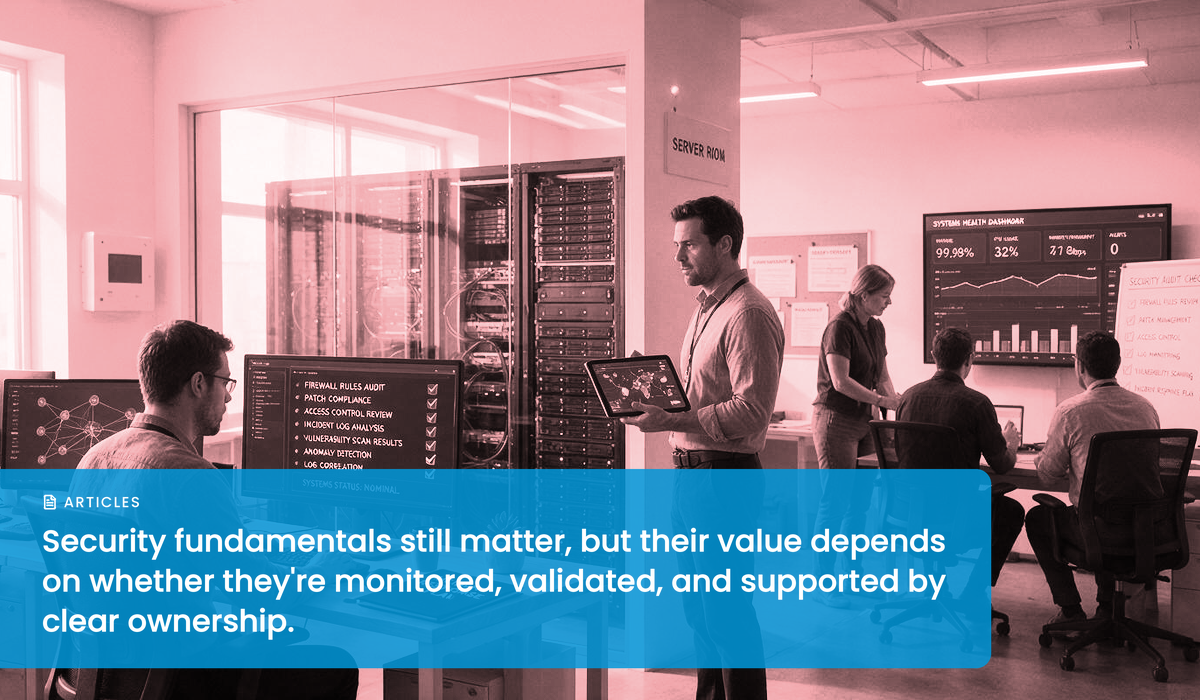
Cybersecurity has become increasingly complex. Organizations are managing expanding attack surfaces, sophisticated identity-based threats, cloud environments, and a growing number of security technologies. Artificial intelligence is also changing how attackers operate, creating new challenges for security teams already stretched thin.
With so much attention on emerging threats and advanced security capabilities, it's easy to overlook the fundamentals.
Multi-factor authentication. Vulnerability management and patching. Security logging. Reliable backups. Incident response planning.
These practices have been central to cybersecurity for years, and they remain some of the most important measures organizations can take to reduce risk.
Yet implementing a security control and maintaining an effective security capability are two very different things.
An organization may require MFA but fail to recognize when an attacker hijacks an authenticated session. It may deploy endpoint protection across its environment without realizing that some devices have stopped reporting. It may collect security logs but lack the resources to investigate suspicious activity. It may maintain backups without regularly testing whether critical systems can actually be restored.
In each case, the organization has invested in a foundational security control. The problem is that the control isn't being consistently monitored, validated, or supported by the processes needed to make it effective.
The challenge for organizations isn't simply implementing cybersecurity fundamentals. It's turning those fundamentals into security practices that work consistently, adapt to changing risks, and support meaningful action when something goes wrong.
Why Are Cybersecurity Fundamentals Still Important?
Cybersecurity fundamentals are the foundational practices, technologies, and processes organizations use to protect systems, data, identities, and business operations from common security threats.
They include measures such as access controls, multi-factor authentication, vulnerability management, security monitoring, data protection, and incident response.
These practices remain important because many successful cyberattacks exploit weaknesses in basic security controls rather than relying exclusively on highly sophisticated techniques. Attackers may use stolen credentials to access an account without adequate authentication protections. They may exploit an unpatched vulnerability, take advantage of an exposed service, or move through an environment where suspicious activity isn't being monitored.
Foundational controls help reduce these opportunities. However, the effectiveness of a security control depends on more than whether it has been deployed. Organizations also need to know whether the control covers the intended environment, operates as expected, and continues to provide protection as systems and threats change.
For example, enabling MFA for employees is an important step toward protecting identities. But organizations must also consider privileged accounts, service accounts, third-party access, authentication exceptions, and suspicious activity occurring after a successful login.
Similarly, deploying a vulnerability scanner doesn't automatically reduce exposure. The organization must identify affected assets, evaluate findings, prioritize remediation, and verify that weaknesses have been addressed.
Cybersecurity fundamentals provide the foundation. Consistent security operations determine how effectively that foundation protects the business.
The Difference Between Implementing and Operationalizing Security Controls
A security control is a safeguard designed to reduce cybersecurity risk. It may be technical, administrative, or physical, and it can serve preventive, detective, or corrective purposes. Implementing a control means putting that safeguard in place. Operationalizing a control means establishing the people, processes, monitoring, and accountability needed to ensure it continues to work as intended.
Consider the difference:
Foundational controlImplementedOperationalizedMulti-factor authenticationMFA is enabled for usersCoverage and exceptions are reviewed, suspicious authentication is monitored, and compromised sessions can be addressedPatchingA patch management tool is deployedVulnerabilities are prioritized, remediation is tracked, exceptions are managed, and fixes are verifiedSecurity loggingLogs are collectedLog coverage is validated, suspicious events are investigated, and monitoring gaps are addressedBackupsBackup jobs are configuredBackup integrity is monitored, restoration is tested, and recovery objectives are validatedIncident responseAn incident response plan existsRoles are assigned, procedures are tested, incidents are investigated, and lessons learned drive improvements
The distinction matters because security environments are constantly changing.
New employees join the organization. Applications are deployed. Vulnerabilities are disclosed. Devices are added or removed. Attackers develop new techniques. A control that worked correctly when it was first implemented may become less effective as these conditions change. Operationalizing security controls helps organizations recognize those changes and respond before they create significant exposure.
1. Multi-Factor Authentication: Protecting More Than the Login
Multi-factor authentication (MFA) is one of the most widely recommended cybersecurity practices. By requiring an additional verification factor beyond a password, MFA helps reduce the likelihood that stolen credentials alone will provide unauthorized access. However, MFA isn't a guarantee that an account cannot be compromised.
Attackers increasingly use techniques such as adversary-in-the-middle phishing, session token theft, MFA fatigue, and social engineering to circumvent or exploit authentication processes. For example, an attacker who steals a valid session cookie may be able to access an application without completing a new MFA challenge, depending on how the application and session controls are configured. An organization may have MFA enabled and still face identity-related security threats.
How to Operationalize MFA
Organizations should move beyond simply measuring how many users have MFA enabled.
An effective approach includes:
Reviewing authentication coverage: Identify accounts, applications, and access methods that aren't protected by appropriate authentication controls.
Prioritizing phishing-resistant MFA: Use methods such as FIDO2 security keys or passkeys where supported, particularly for privileged and high-risk accounts.
Monitoring authentication activity: Investigate unusual sign-ins, repeated authentication failures, unexpected MFA changes, and other indicators of account compromise.
Managing exceptions: Review authentication exclusions and ensure they remain necessary and appropriately controlled.
Establishing response procedures: Define how security teams will revoke sessions, disable compromised accounts, and restore secure access when suspicious activity is confirmed.
The objective isn't just to prevent unauthorized authentication. It's to recognize when an identity may be compromised and respond before that access can be used to cause further damage.
2. Vulnerability Management and Patching: Finding Weaknesses Isn't the Same as Fixing Them
Patching and vulnerability management are essential for reducing the opportunities attackers have to exploit known security weaknesses.
Organizations commonly use vulnerability scanners and patch management technologies to identify affected systems and deploy updates. However, the existence of these tools doesn't guarantee that vulnerabilities are being addressed effectively.
A scanner may identify a critical vulnerability, but the affected system might not have a designated owner. A patch may be available but require downtime that the business hasn't approved. A device may fall outside the scanning schedule entirely. These operational gaps can leave organizations exposed even when vulnerability management technologies are in place.
How to Operationalize Vulnerability Management
Effective vulnerability management requires a repeatable process that connects discovery with remediation.
Maintain an accurate asset inventory. Organizations need to understand which systems exist, who owns them, and how important they are to business operations.
Prioritize based on risk. Vulnerability severity is important, but remediation decisions should also consider known exploitation, external exposure, asset criticality, and potential business impact.
Assign remediation ownership. Findings should be connected to the teams responsible for affected systems, with clear expectations and timelines.
Track exceptions. When a vulnerability cannot be immediately remediated, document the associated risk, compensating controls, and approval process.
Verify remediation. Confirm that patches or other corrective actions have successfully addressed the weakness rather than assuming deployment was successful.
Monitor continuously. New vulnerabilities and assets are introduced regularly, making periodic assessments alone insufficient for maintaining visibility.
The goal is to move from generating vulnerability reports to consistently reducing exploitable exposure.
3. Security Logging: Collecting Data Isn't the Same as Detecting Threats
Security logging provides visibility into activity across an organization's environment. Authentication systems record sign-in events. Endpoint technologies generate security alerts. Firewalls track network connections. Cloud applications maintain activity logs. These records can provide valuable information for identifying suspicious behavior and investigating security incidents. But collecting logs doesn't automatically mean threats are being detected.
An organization may ingest large volumes of security data without having the detection rules, analytical capabilities, or personnel needed to identify meaningful activity. Important systems may also stop sending logs without anyone noticing. As a result, organizations can have extensive logging infrastructure while still maintaining significant monitoring gaps.
How to Operationalize Security Logging
Effective security monitoring requires more than collecting and storing events.
Validate log source coverage. Confirm that critical systems, identity providers, endpoints, cloud services, and other relevant technologies are sending the expected information.
Monitor collection health. Identify missing, delayed, or incomplete telemetry that could create visibility gaps.
Establish meaningful detections. Use detection logic, threat intelligence, and behavioral analysis to recognize activity that may indicate malicious behavior.
Correlate security events. Evaluate related activity across multiple technologies to understand potential attack sequences.
Investigate and respond. Establish clear procedures for reviewing alerts, validating threats, escalating incidents, and coordinating containment.
Review detection effectiveness. Regularly evaluate whether monitoring capabilities can identify relevant threats and adjust detections as attacker techniques evolve.
This is where security information and event management (SIEM), extended detection and response (XDR), and managed security operations can provide significant value. By connecting security telemetry with detection, investigation, and response capabilities, organizations can turn log data into information that supports security decisions.
The value of security logging isn't measured solely by how much data an organization collects. It's measured by whether that data helps identify and respond to threats.
4. Backups: Recovery Depends on More Than Having Copies of Data
Backups are a critical component of business continuity and cyber resilience. They provide organizations with a way to recover information and systems after incidents such as ransomware attacks, hardware failures, accidental deletion, or operational disruptions. However, the presence of a backup doesn't guarantee successful recovery.
Backup jobs can fail. Recovery points may be incomplete. Stored data may be inaccessible. Attackers may attempt to delete or encrypt backups before launching a broader ransomware attack. Even when backup data is available, organizations may discover that restoration takes significantly longer than business operations can tolerate.
How to Operationalize Backup and Recovery
Organizations should evaluate backups as an operational recovery capability rather than simply a data storage process.
Define recovery objectives. Establish recovery time objectives (RTOs) and recovery point objectives (RPOs) based on business requirements.
Protect backup infrastructure. Restrict administrative access, separate backup credentials where appropriate, and use immutable or isolated backups to reduce the risk of tampering.
Monitor backup health. Review job completion, storage capacity, integrity checks, and other indicators that backups are operating as intended.
Test restoration procedures. Regularly restore representative systems and data to validate that recovery processes work.
Document dependencies. Understand the applications, infrastructure, credentials, and personnel required to restore critical business services.
Coordinate recovery with incident response. Ensure recovery procedures account for containment, investigation, and the possibility that restored systems could be reinfected if the underlying compromise hasn't been addressed.
A successful backup job is one measure of readiness. The ability to restore critical operations within acceptable timeframes is the more meaningful outcome.
5. Incident Response: A Plan Only Works if Your Team Can Execute It
An incident response plan defines how an organization will identify, investigate, contain, eradicate, and recover from cybersecurity incidents. It typically establishes roles, responsibilities, communication procedures, escalation paths, and response activities. Having a documented plan is important, but it doesn't guarantee that an organization is prepared to execute it during an actual incident. Security incidents often occur outside normal business hours. Key personnel may be unavailable. Teams may lack the necessary system access or authority to take immediate action. Without regular testing, these gaps may not become apparent until an incident is already underway.
How to Operationalize Incident Response
Organizations should treat incident response as a capability that requires ongoing preparation and validation.
Establish clear responsibilities. Define who investigates alerts, who approves containment actions, and who communicates with internal and external stakeholders.
Document escalation procedures. Ensure teams know when and how to escalate incidents based on severity, potential impact, and business requirements.
Validate response access. Confirm that authorized responders can access the tools, systems, and information necessary to investigate and contain threats.
Conduct tabletop exercises. Test response procedures using realistic scenarios, including ransomware, compromised identities, and cloud security incidents.
Coordinate across departments. Include IT, security, legal, communications, executive leadership, and other relevant teams in response planning.
Review incidents and exercises. Use lessons learned to improve detection logic, response procedures, communication, and recovery capabilities.
Effective incident response depends on preparation, but it also depends on having the visibility and operational resources needed to recognize and investigate threats as they occur.
Why Do Foundational Security Controls Fail?
Foundational security controls often fall short not because the underlying technologies are ineffective, but because organizations struggle to maintain them consistently.
Several operational challenges contribute to this problem.
Security Tools Operate in Silos
Organizations frequently rely on different technologies for identity management, endpoint protection, vulnerability scanning, cloud security, and logging. Each tool provides valuable information, but security teams may struggle to connect findings across them.
For example, an identity platform may record suspicious authentication activity while an endpoint tool identifies malicious behavior on the associated device. When these events remain disconnected, analysts may not recognize that they're part of the same attack.
Security Teams Lack Sufficient Resources
Maintaining foundational security controls requires ongoing attention. Vulnerabilities must be reviewed. Authentication anomalies need investigation. Log sources require validation. Incidents demand timely response. For organizations with lean IT and security teams, these responsibilities can compete with other operational priorities. The result may be delayed investigations, unresolved vulnerabilities, or inconsistent monitoring.
Control Effectiveness Isn't Regularly Validated
Organizations may assume that a control remains effective because it was successfully implemented. However, security conditions change. An endpoint agent may stop communicating. A new application may be deployed without appropriate logging. An administrative account may be excluded from an authentication policy. Without regular validation, these changes can create gaps that remain undetected.
Security Findings Don't Always Lead to Action
Detecting a weakness is only useful if the organization has a process for addressing it. Security tools may identify vulnerabilities, configuration issues, or suspicious activity, but remediation can stall when ownership is unclear or findings aren't prioritized. This creates a disconnect between security visibility and actual risk reduction.
Monitoring Doesn't Extend Beyond Business Hours
Cyberattacks don't follow normal working schedules. Organizations that rely exclusively on business-hours monitoring may experience delays in detecting, investigating, or containing malicious activity. Even when preventive controls are properly implemented, attackers may find opportunities to operate before security teams can respond.
How to Turn Cybersecurity Fundamentals Into Continuous Security Operations
Operationalizing foundational controls requires connecting security technologies with the processes and expertise needed to maintain their effectiveness. Organizations can strengthen their approach by focusing on five priorities.
1. Establish Visibility Across the Environment
Security teams need to understand which assets, identities, applications, and technologies exist across their environments. This includes identifying critical systems, understanding where security controls are deployed, and recognizing gaps in coverage. Without accurate visibility, organizations may not know which systems remain unprotected or which security activities aren't being monitored.
2. Connect Security Data Across Tools
Identity, endpoint, cloud, network, and vulnerability data become more useful when they can be evaluated together. Correlating information across these sources helps security teams understand how individual events relate to broader threats. It can also provide context for prioritizing security findings based on their potential impact.
3. Define Ownership and Response Processes
Every meaningful security finding should have a clear path toward investigation, remediation, or documented risk acceptance. Organizations should establish who is responsible for reviewing alerts, addressing vulnerabilities, maintaining controls, and escalating incidents. Clear accountability reduces the likelihood that important findings will remain unresolved.
4. Continuously Monitor and Validate Controls
Security controls should be evaluated regularly to confirm that they're operating as expected. This includes monitoring endpoint coverage, reviewing authentication configurations, validating log collection, testing backup restoration, and exercising incident response procedures. Organizations should also establish processes for recognizing when changes introduce new security gaps.
5. Measure Outcomes, Not Just Deployment
Traditional security reporting often focuses on whether technologies have been implemented. More meaningful measurements evaluate whether those technologies are producing the intended results.
For example:
Instead of measuring only...Also measure...Percentage of users enrolled in MFACoverage of privileged accounts, authentication exceptions, and time to investigate suspicious accessNumber of vulnerabilities identifiedTime to remediate high-risk exposures and percentage of fixes verifiedVolume of logs collectedCritical log source coverage, collection health, and time to investigate actionable alertsPercentage of successful backup jobsRestoration success rate and ability to meet recovery objectivesExistence of an incident response planExercise results, escalation readiness, and time to contain validated incidents
These measures help organizations understand whether their security programs are reducing risk rather than simply maintaining a collection of tools and policies.
How Can Organizations Assess Whether Their Security Fundamentals Are Working?
Organizations don't necessarily need to introduce new security technologies to begin improving foundational control effectiveness.
A practical starting point is evaluating how existing controls are maintained and validated.
Security leaders should be able to answer several questions:
Do we know which systems and identities are covered by our security controls?
Can we identify when endpoint protection, logging, or other monitoring capabilities stop functioning?
Are high-risk vulnerabilities assigned to owners and remediated within established timelines?
Can we detect suspicious authentication and account activity after a successful login?
Have we successfully restored critical systems from backups within our recovery objectives?
Do we have personnel available to investigate and respond to security incidents outside normal business hours?
Can we demonstrate that identified security issues are being addressed and that corrective actions are effective?
If the answers are unclear, the organization may have opportunities to strengthen its security operations without necessarily replacing its existing investments. The priority should be understanding where operational gaps exist and establishing repeatable processes for addressing them.
Turn Your Cybersecurity Fundamentals into Action with ArmorPoint
Having the right security controls in place is only the beginning. Their effectiveness depends on how well they're monitored, managed, and supported by continuous security operations.
ArmorPoint operationalizes your cybersecurity investments, bringing your existing tools, security data, risk management, and threat response together in one unified ecosystem. With AI-accelerated capabilities and a 24/7 U.S.-based SOC, ArmorPoint helps turn disconnected security controls into coordinated, actionable protection.
Because effective cybersecurity isn't just about the controls you have in place. It's about what you do with them.