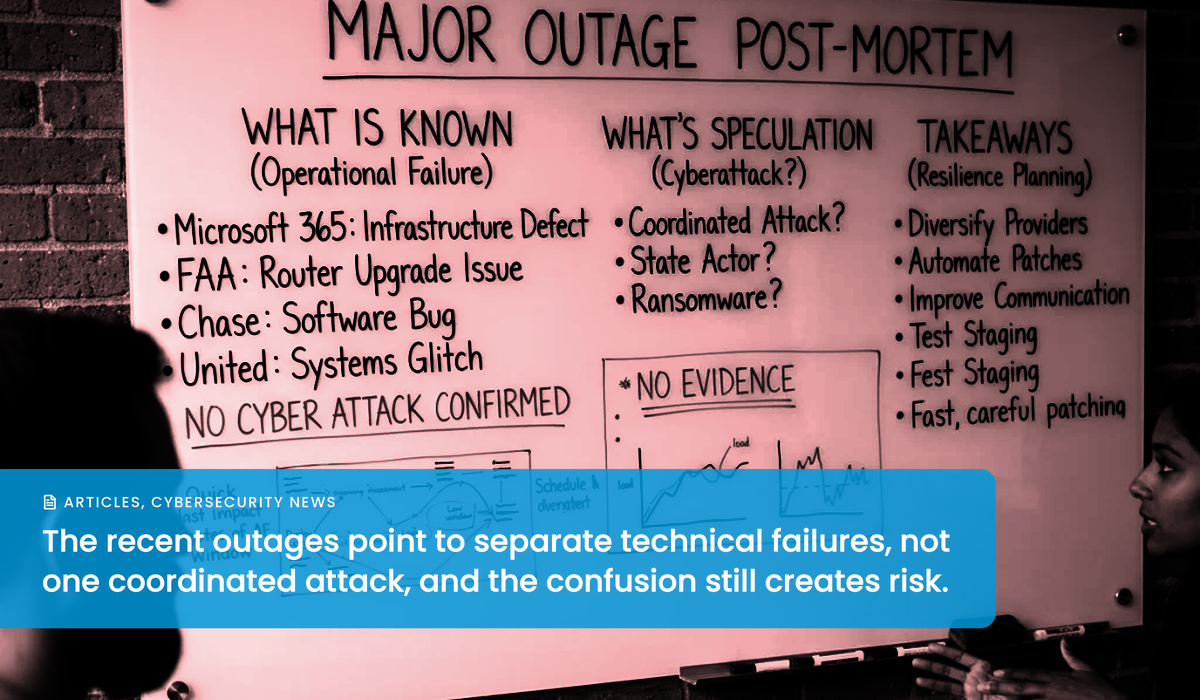
In less than a week, a Microsoft 365 disruption interrupted work, an FAA telecommunications failure grounded flights nationwide, JPMorgan Chase customers encountered transaction problems, and United Airlines experienced a separate systems outage. Then came reports of trouble with an internal National Security Agency network.
It's an unsettling combination. Email, air travel, banking and government communications are the kinds of services people expect to work. When several stumble within days of one another, it's reasonable to wonder whether we're watching something bigger unfold.
But there are three different stories being told at once: operational failures, genuine cybersecurity threats, and speculation that connects events without evidence. They deserve different explanations.
First, what do we actually know about the outages?
The public explanations so far point to separate technical problems, not one confirmed coordinated attack.
Microsoft attributed its November 12-13 service disruption to technical issues involving its infrastructure. The FAA identified instability in the telecommunications network associated with modernization work. Chase described a software problem and said it had no evidence the event was cyber-related. United Airlines also said it had no indication of a cybersecurity-related cause.
On November 17, the NSA said it had experienced a temporary degradation during scheduled routine maintenance and that mission-critical capabilities remained operational.
Later that day, Director of National Intelligence Jay Clayton said the NSA disruption came from applying a patch for the critical PHP vulnerabilities disclosed in October, which kept some systems from coming back up as expected. According to the Associated Press, he also told CNBC that the disruptions were not a cyber attack or a coordinated nation-state effort, and attributed them to institutions and companies pushing through system upgrades at around the same time. Several of the other outages also began with a change: a software fix at Microsoft and an equipment upgrade at the FAA.
Those statements don't mean every investigation is finished. They do mean that no publicly established evidence ties these disruptions to a single attacker. Reuters reported that U.S. officials also saw no indication of a coordinated cyber attack.
It's important to hold two ideas at once: investigators should follow the evidence wherever it leads, and the public shouldn't have to invent a malicious cause when an operational explanation is already supported.
An outage and a cyber attack can look similar from the outside
For someone locked out of a critical application, the immediate experience is the same: the service isn't working. But a failed software change, a capacity problem, an equipment fault and unauthorized activity are not the same kind of event.
A cyber attack doesn't even have to cause downtime. An attacker may want a system to keep running while they quietly use stolen credentials, access information or move through the environment. Some attackers abuse legitimate administrative tools and processes (a technique often called living off the land) to make malicious activity look more like ordinary operations.
That is why a service-health dashboard alone cannot answer a cybersecurity question. Investigators need context: what changed, which systems were affected, what the available logs show and whether there's evidence of unauthorized behavior.
AI is changing attacks. It didn't cause these outages directly.
There's a legitimate reason AI has entered this conversation. On November 13, the FBI warned about ARTEX, an AI-driven penetration-testing framework that malicious actors have used to automate stages of intrusions. The agency reported that some observed intrusions advanced from initial targeting to privileged access in under three hours.
A November 16 report from Google Threat Intelligence Group and Mandiant similarly describes attackers using multi-agent frameworks to accelerate reconnaissance and exploit development.
These findings are important because they show that offensive automation is not merely a future possibility. It is being observed in real-world activity. They also require perspective: a faster attempt is not necessarily a successful compromise, and these research findings do not show that AI caused the Microsoft, FAA, banking or airline disruptions.
There is an indirect connection, though. AI is helping researchers find software flaws faster than ever, and organizations are racing to patch them. Former CISA Director Chris Krebs said the pace of patching is now far beyond anything in the past, and that any update can destabilize a system. The DNI tied the NSA outage directly to that kind of patching. Meanwhile, Google's report shows attackers using AI to turn newly published patches into working exploits, which pushes everyone to patch even faster. AI didn't attack these systems, but it's adding pressure from both sides.
AI belongs in a serious discussion about how quickly real threats can unfold, not as a default explanation for every technical failure.
An ordinary outage can still create a cybersecurity problem
Even when attackers didn't cause an outage, they can take advantage of it.
Following the Microsoft disruption, Microsoft Threat Intelligence documented emails impersonating service-health notices. The messages warned that held emails would be deleted unless recipients followed a link. Microsoft assessed the activity as likely credential phishing, but did not establish that credentials had been stolen or that accounts were compromised in the activity it examined.
The distinction is revealing: the outage was a technical event; the fraudulent messages were malicious activity exploiting awareness of that event.
It is entirely possible for an organization to experience an operational problem and face a separate cyber threat related to the confusion around it. Security teams must be able to evaluate both without treating them as one incident.
So, are we becoming more vulnerable?
The recent events highlight two kinds of exposure that often get discussed together but require different responses.
The first is technology dependency. Businesses rely on cloud providers, software platforms, communications networks and outside services that they don't control. An interruption at one provider can affect employees and customers across many organizations.
The second is security exposure. Widely used software can contain serious vulnerabilities, third-party code can introduce risks, and attackers can increasingly automate parts of their work. Those risks make accurate inventories, access controls, monitoring and response processes more important.
None of this means that one dramatic week proves the internet is failing more often, or that every business should abandon its core providers. It means organizations should know what they depend on and how they would operate, and investigate, when something important goes wrong.
What should businesses do with this information?
Three questions are a practical place to start:
- What would stop our business if it became unavailable? Identify the services, providers and connections that support essential operations, and know how you'll communicate during an interruption.
- Could we recognize a genuine security incident amid an outage? Know which security telemetry is available, who reviews it and what happens when a key monitoring tool is itself degraded.
- Who can make a decision when the evidence is incomplete? Establish incident contacts, escalation responsibilities and after-hours coverage before a disruption occurs.
A strong response depends on understanding both the business impact of a technology failure and the evidence of possible malicious activity. Those are related responsibilities, not interchangeable ones.
The question isn't whether every headline points to the same hidden cause. It's whether an organization can get to a reliable answer about what happened, what it affects and what to do next.